Event Management in Saudi Arabia: An Organiser's Guide
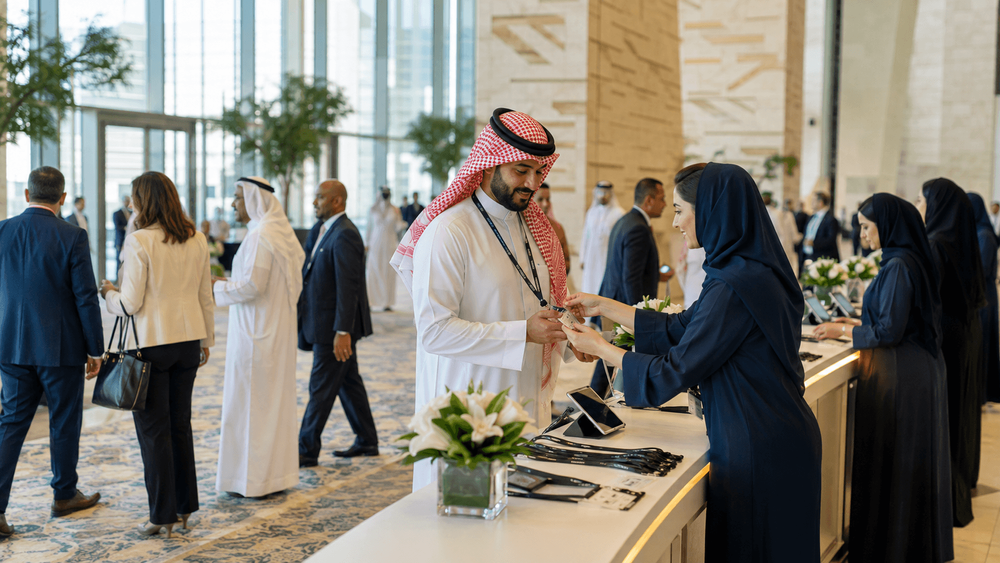
A successful business event in Saudi Arabia depends on several plans working together: the right approval route, a suitable venue, clear registration rules and an attendee journey that remains consistent from the first invitation to the final follow-up. A polished website cannot compensate for uncertainty about who may attend, whether a payment is confirmed or which team can approve a last-minute change.
For international organisers, the starting point is to define the event and its delivery structure before copying a process used elsewhere. A conference, exhibition and private corporate meeting may raise different questions, while the responsible organising entity, venue, programme and supporting activities all influence the work that needs to be verified.
This guide provides an operational framework for organising that work, with Arabic and English registration, payment handling, communications and arrival planning treated as connected parts of the same event.
This is general planning information, not legal or licensing advice. Confirm the current requirements for your event with the relevant authorities and a qualified Saudi-based adviser before making commitments that depend on them.
Define the event and who is responsible for delivery
Begin with a short event brief that identifies the business objective, intended audience, format, capacity and proposed city. Include whether access is paid or free, whether exhibitors or sponsors are involved, and which activities sit outside the main conference programme.
Next, identify the responsible organising entity and the roles of the local partner, venue and specialist suppliers. An international team should know who will submit applications, hold supplier contracts, answer attendee questions and make event-day decisions, rather than assuming these responsibilities belong to the venue.
This brief should be specific enough to support official and commercial discussions. If the format changes, such as adding an exhibition area or an evening activity, review the approval and delivery implications before treating the new element as confirmed.
Verify licences and approvals before dependent activity begins
For conferences and exhibitions, the Saudi Conventions and Exhibitions General Authority's official services are a starting point for checking the appropriate route. The Saudi national service portal, for example, identifies a separate approval service for government entities, illustrating why the applicant and event category matter.
Do not assume that a previous organiser's checklist applies unchanged to your event. Verify the current service, eligible applicant, required inputs and conditions with the authority or responsible local adviser, including whether other activities require separate permissions. Avoid building your timetable around an old presentation or an unverified application estimate.
Maintain an approval register showing the requirement, owner, dependencies, submission status and evidence of completion. Ask specifically which permissions need to be in place before promotion, registration, ticket sales or particular supplier commitments, then sequence those activities around the verified answer.
If an approval remains unresolved, the plan should show who can decide the next step and which work must wait. This prevents a marketing deadline from becoming an informal substitute for an actual go-ahead.
Choose the city and venue around the attendee journey
The venue decision affects much more than room capacity. Review travel access, accommodation, arrival routes, accessibility, registration space, movement between sessions and the practical needs of exhibitors, speakers and production teams.
A useful site visit follows the attendee's route rather than only the organiser's tour: where a vehicle stops, how the entrance is found, what happens when several hundred people arrive together and where someone goes if their registration cannot be found. Check that a queue at the desks will not block a main entrance or another function.
Work with the venue and local team on programme timing, catering and prayer arrangements that suit the specific audience and date. Clarify operating hours, loading access, supplier restrictions, emergency procedures and who can authorise changes, rather than leaving these details inside separate supplier conversations.
Connectivity deserves a practical test in the actual registration area. Confirm the available network, power, coverage and support route, then agree a contingency suitable for the event instead of treating a general promise of venue Wi-Fi as a delivery plan.
Build one Arabic-and-English attendee journey
Offering Arabic and English should mean more than translating the landing page. The attendee's chosen language needs to remain understandable through registration, confirmation, payment instructions, support, event updates and any badge or ticket they receive.
Review the full Arabic layout, including right-to-left behaviour, mixed Arabic and Latin content, numbers, email addresses and controls. A translated sentence may be correct while the surrounding form is confusing, so involve fluent reviewers and test on the devices your audience is likely to use.
Names deserve particular attention because a registration name, a badge name and a name required for a separate official process may have different purposes. Explain what is needed, support the relevant characters and avoid forcing everyone into a naming pattern that does not fit them.
Dates, times, phone numbers and currencies should be unambiguous in both language paths. Where teams work across time zones, distinguish the event's local time from internal planning times, and test calendar links as carefully as the visible programme.
Assign ownership of both versions and a review process for changes. If a room or registration condition changes in English, Arabic should not remain on the previous version until someone happens to notice.
Design ticketing, payments and reconciliation together
Before configuring the form, agree the attendee categories and what each one allows. Consider invited guests, speakers, exhibitors, paid delegates and group bookings, including whether approval is required before a place becomes confirmed.
Capacity should follow the real resource being reserved, which may be a full-event place, a workshop seat or a particular date. Document what happens after a cancellation, whether a waiting-list place can be offered and who can make an exception, then test those decisions with realistic examples.
For paid events, agree the payment methods with your financial provider and intended audience rather than assuming one method will suit everybody. Finance and a qualified adviser should verify the relevant tax and invoicing requirements, while the operational team defines refunds, cancellations, discounts and the handling of failed or delayed payments.
Make payment and registration status distinct enough that staff do not mistake a submitted form for a paid booking. A delegate who forwards a payment screenshot needs a clear review route, and any manual adjustment should leave the authoritative records consistent.
Test the full cycle, including a failed payment, a retry, a refund and a group booking change. These cases reveal more about operational readiness than a single successful transaction.
Send communications when attendees need to make decisions
Build a communication plan around the questions an attendee will have: whether registration succeeded, whether payment is complete, how to reach the correct entrance, what to bring and whom to contact when something changes.
Each message should have an owner, trigger, audience and language version. A confirmation for an approved delegate should not accidentally go to somebody whose application is pending, while a cancelled attendee should not continue receiving instructions that imply their place is active.
Review dynamic information such as names, ticket categories, dates, links and payment references in both languages. Test the links from an actual received email or message, because a correct template inside the system does not guarantee that the final journey works on a phone.
Agree how urgent changes will be approved and distributed, and make sure support staff receive the same information before delegates start asking questions. Where interpretation of bilingual terms matters, have the appropriate adviser agree the wording and any statement about authoritative versions.
Rehearse arrival, badges and the exception desk
Plan for the arrival peak rather than the average number of attendees across the day. Estimate when different groups are likely to arrive, how long a normal transaction takes and which cases need more attention, then use those assumptions to design the desks and staffing.
Separate straightforward check-in from work such as missing registrations, unpaid bookings, substitutions and badge corrections. An exception desk keeps a complicated case from stopping the main queue, provided staff know who can resolve it and what evidence they should check.
Include speakers, VIPs, exhibitors, groups and walk-ins in the rehearsal where they are relevant. Test badge readability in Arabic and English, scanning conditions, printer supplies, device charging and the handling of duplicate or damaged tickets.
The contingency should be a documented process, not an assumption that software works offline. Verify the actual platform behaviour, and if a restricted manual list is part of the plan, define how it is protected, updated and reconciled afterwards. Staff should know when to switch to the contingency and when to escalate rather than improvise.
Keep Saudi and European data requirements distinct
For a Saudi event, review the Saudi Personal Data Protection Law and relevant implementing and transfer requirements with the appropriate adviser. SDAIA's official laws and regulations resources provide the current reference point; a software vendor's general privacy statement is not a substitute for this review.
Map the information collected, its purposes, responsible organisations, suppliers and access locations, including overseas support and exports. Confirm the appropriate notices, agreements, security arrangements, retention decisions and process for attendee requests, while giving additional attention to information that may need more protection.
Where your organisation or processing also falls within the GDPR's scope, run a separate assessment. A European nationality on an attendee list does not by itself settle that question, and hosting an event outside the EU/EEA does not automatically remove GDPR responsibilities. The European Commission's guidance on GDPR application explains the relevant scope framework.
Neither regime should be presented as replacing the other, and compliance should not be inferred from a hosting location alone. For the European side of the workflow, our GDPR guide for event registration offers practical questions to take into the review.
Put dependencies into one event command plan
The command plan should bring together the timeline, approvals, owners, contacts, supplier dependencies, communications and incident escalation. It need not be complicated, but it must be current enough that the team can use it when a decision is urgent.
Use the following checklist as an in-page starting point, adding a named person and evidence for each item.
| Delivery gate | What must be clear | Who should confirm |
|---|---|---|
| Before dependent promotion or sales | Applicable permissions, confirmed claims and conditions for proceeding | Organising entity and local adviser |
| Before registration opens | Ticket rules, bilingual journey, payment handling, privacy information and support process | Registration, finance and privacy owners |
| Before final attendee instructions | Entrance, timing, transport information, programme and contact details | Venue and communications leads |
| Before doors open | Staff rehearsal, equipment, capacity, exception handling and contingency | On-site lead and key suppliers |
| Before event closeout | Financial reconciliation, supplier deliverables, access removal and data decisions | Event owner, finance and privacy lead |
A go/no-go review should expose unresolved items rather than simply confirm that the date has arrived. Record any accepted operational exceptions, their owner and the fallback, while keeping legal or approval questions with the people authorised to resolve them.
Where PLANARA can fit
PLANARA's public product information describes multilingual event websites, tailored registration and ticketing, badge scanning and attendee updates. For a bilingual conference, these are useful areas to explore as parts of one attendee journey rather than as isolated features.
Bring your actual Arabic-and-English flow, ticket categories and arrival scenarios to the demonstration. Ask to see the process your team needs, including changes and exceptions, and distinguish demonstrated capability from work that would need configuration, customisation or a separate service.
Specific Saudi payment methods, local regulatory suitability, data residency, integrations and offline operation need explicit verification. Our event software buyer's guide can help you turn these questions into a structured evaluation.
Frequently asked questions
What should we verify before organising a Saudi business event?
Start with the event category, responsible applicant, applicable approvals, venue conditions and delivery partners. Then connect those decisions to registration, payments, communications and on-site responsibilities.
Where should we check current approvals?
Use the relevant authority's current services, including SCEGA for conference and exhibition questions, and confirm your specific route with a qualified local adviser. Avoid relying on an old event's fee, deadline or licence checklist.
How should Arabic and English registration work together?
Treat them as two complete versions of the same attendee journey, with consistent rules and coordinated updates. Test layout, names, dates, messages, payment instructions and badges, not only the opening page.
What should we test before opening registration?
Test each attendee category and language, successful and failed payments where relevant, capacity rules, confirmations, corrections and support escalation. Include mobile use and the handoff into check-in.
How should international organisers manage attendee data?
Review Saudi requirements and any other applicable regime separately, with a map of purposes, vendors, access locations and transfers. Agree retention and closeout arrangements before information begins moving between suppliers.
Verify locally, then operate from one plan
Reliable event management in Saudi Arabia combines local verification with a consistent attendee experience and a rehearsed delivery team. Once approvals, bilingual content and operational responsibilities are connected, changes become easier to manage without losing control of the event.
To discuss a registration journey for your next conference or corporate event, book a PLANARA demo.